Sermon: Chayei Sarah
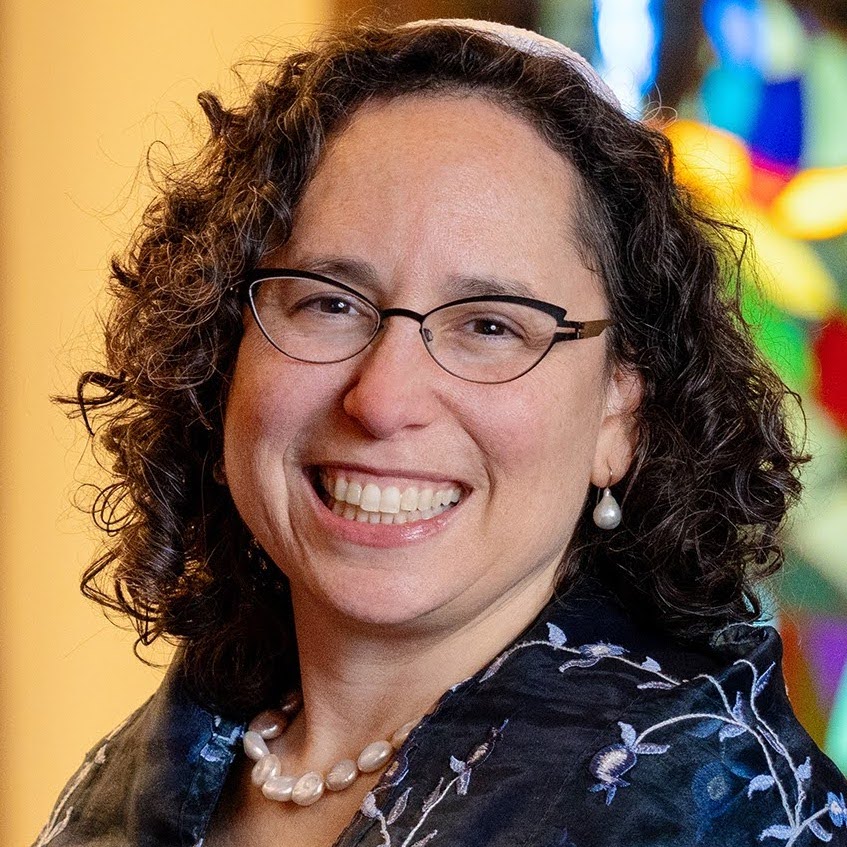
Sermon: “In Celebration of 40 Years of Conservative Women Rabbis” by Rabbi Julie Roth
My path to the rabbinate began at Dartmouth College, my freshman year, in a class on Women in the Hebrew Bible and at the Women in Science Fair, where I presented my research on a biodegradable sponge that delivered chemotherapeutic drugs to the surgical site where a tumor was removed. I showed up to the first day of class with the attitude, show me an entire syllabus on Women in the Hebrew Bible, there’s not enough material to study for 10 weeks. And I noticed at the science fair that I enjoyed talking about my research with others far more than doing it. I ended the class with a paper on the Initiative of Women in the Hebrew Bible, featuring a long section on our matriarch, Rebecca. When I received a citation in the class, which is a rare A+, my parents didn’t seem to appreciate the significance; so I purchased a copy of Judith Plaskow’s feminist work, Standing Again at Sinai, with my parents’ credit and said thank you for buying me the perfect gift to recognize my achievement in this class. Though I suspect the OPLA sponge went on to be certified by the FDA and saved the lives of lung cancer patients, by my sophomore year, I had already switched my major from Biology to Religion. When my father asked me, ‘what are you going to do with a major in Religion?’, I really had no idea.
* * *
“They didn’t open the gates of the Seminary, we kicked them down”, Rabbi Debra Newman Kamin said this past week at a gathering in celebration of 40 years since the ordination of the first female rabbi in the Conservative Movement in 1985. Rabbi Amy Eilberg was admitted to the rabbinical school at the Jewish Theological Seminary in 1984 and was ordained one year later in 1985 because she had already taken so many credits in the graduate school as a student of Talmud. She was tough and hard-headed and not really in touch with her feelings. She told us that when the Jewish Theological Seminary recognized the 40th anniversary of her ordination by giving her an honorary doctorate this summer, suddenly, she was flooded with traumatic memories from the past. She recounted to us reading Torah at a Rabbinical Assembly convention, and the whole room shouting out the correction of a trope she missed. In those days, women didn’t have to be just as good as the men they had to be perfect. If you were in touch with your feelings, you wouldn’t have made it through.
* * *
My sophomore year of college at Brown, I was surrounded by feminist rock stars, like my roommate Rachel Alexander who started wrapping tefillin in high school. Everyone else seemed to already wear a tallit and because, well you might guess, I wanted to lead the davening, I asked my parents for a tallit for a Hanukkah present that year. I remember feeling like Eve eating from the apple and suddenly realizing I was naked without one. But what really changed my life was attending a Jewish Women’s conference at Harvard Hillel. That’s where I saw women rabbis for the very first time. I actually hadn’t heard the news in Cleveland, Ohio, that a handful of women had been ordained by the Conservative Movement while I was in middle school and high school. And at this conference in 1992, there was not one but four female rabbis. Rabbi Elyse Winick, from Brandeis, was pregnant, a shock for me to see. I remember going to lunch and looking around the room and thinking, I can sit at any one of these tables and I’ll be sitting with a woman rabbi.
* * *
Rabbi Stephanie Dickstein, one of the members of the first class of women admitted in 1984 had wanted to be a rabbi since her Bat Mitzvah. She had been a student at the Seminary as an undergraduate and as a graduate student in the joint program with the social work school at Columbia. Her professors, even the ones who opposed women’s ordination, knew her as a student for many years before she entered rabbinical school, so they were kind to her, even though they didn’t believe she belonged in the rabbinical school. She remembers sneaking into the mailroom of JTS to slip hand-written letters into the faculty mailboxes the day of the vote, only to find out the vote was tabled. In the end, the vote took place the day after her wedding – she found out the news from a newspaper in the hotel lobby. She hadn’t said anything about her desire to become a rabbi to her husband or her in-laws because she didn’t think it was going to happen. Her Orthodox in-laws had to be comforted the day after her wedding with the words, “at least your daughter-in-law is Jewish.”
* * *
We sat in a circle, in a room upstairs at Harvard Hillel, each taking turns holding a beautiful, exotic flower, I had never seen before, the striking purple and orange Bird of Paradise. We were asked to introduce ourselves by our matriarchs. I remember the feeling of electricity in the room, the power of naming the women who came before us. It’s hard to explain, but this was a time when women’s stories were always at the margins, either unknown or de-emphasized, and they were never front and center in our textbooks or our prayerbooks or even our own stories. As my turn approached, I started practicing in my head because I was nervous. “I am Julie, the daughter of Alice, the granddaughter of Margaret and …”. I realized I couldn’t in that moment remember the name of my father’s mother, the one who was killed in Auschwitz-Birkenau. I knew almost nothing about her, I had only seen a picture of her on her wedding day. My father rarely spoke of her because the memories were too painful. By the time the flower was passed into my hands, I remembered. “I am Julie, the daughter of Alice, the granddaughter of Margaret and Golda”, I said. In that moment, I realized even as many stories as had been lost in the Holocaust, throughout the history of the Jewish people, even more stories of Jewish women had been lost.
* * *
Rabbi Julie Gordon was a student at JTS in 1978, but when the vote was postponed, she enrolled in rabbinical school at Hebrew Union College. She remembers the first time she wore tefillin at HUC, one of the professors walked in and said, “Jesus Christ – tefillin!” not because she was a woman wearing tefillin but because no one wore tefillin in the Reform Seminary in those days. She served in her first congregation in Brooklyn, the year after they voted to count women in a minyan. When she interviewed with the membership committee of the Rabbinical Assembly, to come home to the Conservative Movement, they asked her about her mikveh practice. She said, “my practice is to take converts to the mikveh and to take both brides and bridegrooms to the mikveh before their wedding day. As for my personal practice of mikveh, related to taharat hamishpachah, women and menstruation, I’ll be glad to share my practice after each one of the men on this panel disclose their personal practice with me.
* * *
I came back from that conference at Harvard on fire. Though I had never really organized much of anything at that point in my life, I just knew we had to have another conference, a regional Jewish Women’s conference, and whatever it took, I was going to make it happen. I was just beginning to find my voice as a Jewish feminist and as a leader. It would take me six more years to muster the courage to apply to rabbinical school. Together with friends from Brown and college students from up and down the eastern seaboard, we planned a second conference which we called, “Jewish Women: Listening to Our Voices”, a gathering of over 80 college students from 16 different schools. I had never been so passionate about anything in my entire life, and through the planning of that conference, I discovered my leadership capacity to translate dreams into reality. And because Hillel was the framework that empowered me to become a leader, I decided then that I wanted to become a Hillel Director. It was a few years later while working at Tufts Hillel, in a moment when I offered as student a blessing of healing, something I never had done before, that I decided I wanted to become a rabbi.
* * *
Rabbi Susan Grossman, a long-standing member of the committee on Jewish Law and Standards, worked with other pioneering women to create rituals we take for granted, like simchat bat, the baby naming ceremonies for welcoming daughters into the covenant of the Jewish people. She was studying in Israel at the time women were allowed to apply to rabbinical school, and they couldn’t find any rabbis to interview her for rabbinical school. She remembers one time she was praying with tefillin, and one of her classmates was so angry, he came at her and needed to be held down by several classmates to avoid an altercation. Her mentors told her that none of the women rabbis would have automatic authority because everyone associated God with male attributes; instead they would have everyone’s relationship with their mothers’ projected unto them. When she interviewed for her first pulpit, she was pregnant; she judged the readiness of the congregation not by whether they asked hostile questions, but by how they reacted to her answers to their hostile questions. Rabbi Susan Grossman was the Associate Editor of the Etz Hayyim Humash we use every Shabbat, and the first to integrate women’s Torah commentary into a mainstream Humash.
* * *
It took my parents and brothers several years to get used to the idea of my becoming a rabbi, but by the time I entered, my parents were both very supportive. They traveled around the country on Rosh Hashanah to join me at my student pulpits, and my father often helped me by reading Torah and leading Shacharit. I remember a walk I took with my father to shul one of the last weeks before I started JTS and saying to him, you know dad, you were the one who inspired me to become a rabbi. And he said, gently in his way, I know. And I think you’re going to make a wonderful rabbi. There were many times when we would sit together at the morning minyan my father led as shamash at my home synagogue, each wrapped in tefillin. Inevitably, someone would say something along the lines of Jonathan, did you ever imagine you would be sitting here next to your daughter wrapped in tefillin? And he would smile with his big smile as if to say, I know what you mean, and I couldn’t be prouder, and it’s time for you to get with the program.
* * *
At the conference celebrating 40 years of women rabbis in the Conservative Movement, we created a wall with a historical timeline where each one of us wrote down each time we were the first to do something. I wrote that I was the first to add the imahot to the Amidah from the bimah of Beth Am Synagogue in Cleveland, Ohio in 1993. And I noted that I was the first woman rabbi to serve as Hillel Director at an Ivy League Hillel. And of course, I proudly added to the wall that I was the first woman to serve as rabbi at Congregation Shomrei Emunah in its more than 100-year history. It was both powerful and healing to be with such a large gathering of women who understood that it was sometimes painful or lonely to be the first and that we broke the stained-glass ceiling because we felt we had been born into this world to become rabbis. I imagine that’s how Regina Jonas must have felt when she became the first woman to be ordained as a liberal rabbi in Germany in 1941. Her story is often forgotten because she perished at Theresenstadt. The Holocaust set back the ordination of women rabbis by thirty years. The next woman to be ordained as a rabbi was Sally Preisand, ordained by the Reform Movement in the United States in 1972, the year before I was born.
* * *
The last day of the conference, I gave a d’var Torah and shared the story of a dream I had the summer before I went to rabbinical school. In that dream, I met my grandmother Golda in a field, green as far as the eye could see. I had wondered how my Orthodox grandmother, the mother of eight children, the one with the beautiful singing voice and the red highlights in her hair, would have felt about my becoming a rabbi. In my dream, we stood facing each other in silence because we did not share a common language. I did not speak Yiddish or Hungarian, and she did not speak English. I searched her face for an answer, and then suddenly she stepped forward and embraced me, holding me tight in her arms. In that moment, I knew I had her blessing.
I wanted to extend that embrace, that sense of acceptance and blessing to the 75 women rabbis who gathered together from Israel, South America, Europe and the United States to celebrate this milestone, so I blessed them in the names of our imahot, Sarah, Rebecca, Rachel and Leah. I ended my blessing with these words:
Here we stand before you, arm in arm, embracing you as women rabbis, your foremothers, Sarah, Rivka, Rachel, v’Leah. We are grateful that you invoke our names every time you pray the Amidah, whether our names are written in your hearts or on the pages of your prayerbooks. Every time you pray our names out loud or in your heart, remember we are also praying for you. Feel our embrace and be strengthened by our blessings. May you never forget that the brit olam, the everlasting covenant made through us, continues through you. Though you are not yet too numerous to count, the impact that your Torah, your caring, and your leadership has had on the Jewish people is beyond our wildest imagination. Every moment and every person you have inspired, collectively, is as numerous as the stars in the sky.
Shabbat Shalom.
Other Sermons and Talks from the Bimah
See the blog category: Sermons & Talks
Video Archive
The archive of all Shomrei videos is available on our YouTube Channel at shomrei.org/video