Sermon on Shabbat Vayeshev
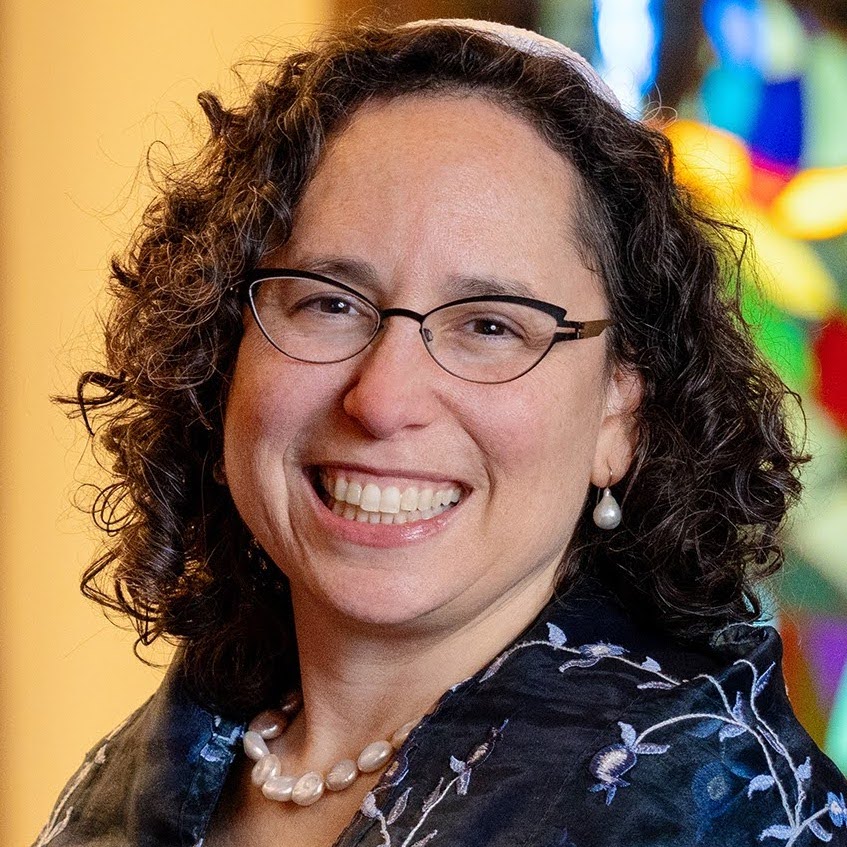
Sermon: “Hanukkah 2025” by Rabbi Julie Roth
“It was a cold December night in Billings, Montana. Christmas lights twinkled on many houses, and from a few homes, Hanukkah menorahs shone in the darkness. It was the third night of Hanukkah. At Isaac Scnitzer’s house, there was a menorah in almost every window. Isaac was in the den doing his math homework[1]”, when he heard a loud crash coming from his bedroom window.”
The children’s book, Christmas Menorahs, by Janice Cohn and illustrated by Bill Farnsworth pictures Isaac standing in his bedroom with his babysitter, Mrs. Davis, staring out of the gaping hole in his bedroom window, standing a few inches from his bed, with his electric menorah, with its shamash bulb and three candle bulbs lit, lying on the floor. “Pieces of glass covered the floor, and on Isaac’s bed was a big rock.” Isaac with his big round glasses asks out loud, “What if he had been in bed when the rock came flying through?[2]”* * *
Our sages, could not have imagined an electric Menorah like Isaac’s, plugged into the wall and illuminated by electricity rather than olive oil, but they did debate the question, how many Hanukkah menorahs should each family light. In the tractate of the Talmud that discusses Shabbat, there is an extensive discussion, ba’meh madlikim, about how we light candles; In addition to discussing the rules and regulations for lighting Shabbat candles, the Talmud illuminates how we light the candles for Hanukkah. The basic requirement is for each household to light one Hanukkah menorah for the entire family. And the mehadrin, those who go above and beyond, light a Hanukkah menorah for each and every person in the household.
Our sages also ask the question, if the light is extinguished, are we obligated to rekindle it?[3]
* * *
When Police Chief Inman came to the house, he suggested that Isaac’s family consider taking down their Hanukkah decorations for their own protection. This incident was part of a growing pattern of hate in their small town of Bilings, Montana. In the book, Chief Inman explains, “First they sent out leaflets saying hateful things about Jews and some other groups who live [there]. Then they spray-painted threats and insults on a Native-American home and tried to frighten African-Americans in their church. Last week, they damaged the synagogue. Now they’re throwing rocks at menorahs. But I can tell you this – We’re going to do everything we can to stop them.”[4]
Chief Inman left, and Isaac’s parents remained with the task of explaining to their elementary school kid why someone would hate their family just because they were Jewish. Isaac’s “dad put his arm around him. “I know how you feel, he said. “It’s frightening. But celebrating Hanukkah is part of being Jewish. It’s what we believe in. We’re not about to let some bullies keep us from celebrating our holiday.” “Dad, right, Isaac,” his mom added. “We come from a family of pioneers. They came to Montanna so they could do things their own way. In a sense, I guess, we’re pioneers, too.” “But I don’t want to be a pioneer,” Isaac protested. “I want to be like everyone else.”
* * *
I remember when my kids were in elementary school – we were living in Princeton. At this time of year, they would always talk about how they were one of the only kids in their class whose families celebrated Hanukkah, and sometimes the only kids who celebrated Hanukkah without also celebrating Christmas. More than any other time of year, this was when they felt different for being Jewish. I guess with two rabbis as parents, they didn’t ask, as many Jewish kids do, why can’t we celebrate Christmas. But like Isaac, they wrestled with being different.
We always lit our Hanukkah Menorah in the window, as is customary, but when the candles burned out, there was no external sign at our house that we were celebrating Hanukkah. I’m not sure exactly what inspired it, but Justus decided to build our own large electric menorah to put on our front lawn. I can’t say it was beautiful, but it was definitely noticeable. Fortunately, he improved on the design when we moved to Montclair. And now, since I can remember, in addition to lighting the candles in the window, we light a large public menorah on our porch.
* * *
After Isaac’s mother was interviewed by a television reporter and people read about what happened in the newspaper, a special meeting was called by Chief Inman and a woman named Margaret MacDonald. Chief Inman told the crowd, “It’s important that we take a stand as a community. We have to show that an act of hate against even one person in Billings is an act of hate against all of us!” And then Ms. MacDonald shared an idea that was inspired by a story her parents had told her when she was a little girl. The story was about how the people of Denmark reacted during World War II when the Nazis invaded and ordered the Jews to sew stars on their clothing so they could be easily identified. She was inspired by the legend that King Christian, the Denmark King, rode out of the palace on horseback, wearing a Jewish star, and soon many of the people of Denmark were wearing them too.
This was the inspiration for her idea that all the residents of Billings, Montana should put menorahs in their windows.
* * *
The Talmud also teaches, “ner Hanukah mitzvah l’hanichah al petach beito m’bachutz”, it is a mitzvah to place the Hannukah lights at the opening of our house so it can be viewed from outside. Rashi explains this is for the sake of pirsumei nisa, of publicizing the miracle of Hanukkah. But that begs the question, why specifically on Hanukkah, and not on other holidays, is the publicizing of the miracle emphasized?
I recently learned that during the time when King Antiochus and the Syrian-Greeks ruled over Israel, they not only took over the Temple and descecrated, they not only forbid Jews from studying Torah and practicing Judaism in private, but they also demanded that the Jews denounce their allegiance to the God of Israel in public. How did they do this? By requiring them to publicize their abandonment of their Jewish faith by writing it on the horns of oxen. Why would they make such a strange request? Because in those days, people traveled by wagons and chariots that were driven by oxen and the horns of the oxen were the most visible thing you could see on the roads. The Syrian-Greeks demanded that our ancestors write their betrayal of their traditions on the horns of oxen so it could receive the widest publicity possible. I believe this teaching was the inspiration for the Chabad custom of driving around with a menorah attached to the top of the car or sitting on a truck. And for the rest of us, it is the inspiration for at least lighting our Hanukkah menorahs in our windows.
* * *
There’s an illustration of Isaac in the car with his mother, driving through the snowy streets of Billings, Montana. They are looking at each other, smiling, and in the background, a house is light up with a Christmas tree in the window and next to it, taped to the window, is a large picture of a Menorah. “It was getting dark as Isaac and his mother began to drive slowly through the neighborhood. “Look, Mom!” Isaac cried. “Look at all the menorahs!” In house after house, in the frosty windows, Isaac could see pictures of menorahs. There wasn’t a single street without the Hanukkah symbols.” Isaac asks if anyone threw rocks through the windows and Isaac mother says, “yes they did” but that only made people more determined. “The Billings Gazette printed a full-page picture of a menorah and asked people to display it on a door or window in their homes. And they did, Isaac – people put up thousands of menorahs.”[5] At the time of this incident, not even 100 Jews lived in Billings, Montana and they put of thousands of Menorahs.
* * *
On the holidays of Passover and Purim, we also publicize the survival of the Jewish people. On Passover, we drink four cups of wine to celebrate how God took us out of Egypt and on Purim we read the story of Queen Esther. These miracles of survival we publicize internally within our families and within our communities, we are not asked to publicize these miracles to the broader world. Why then on Hanukkah do we publicize the miracle to all of our non-Jewish neighbors as well? According to Rabbi Joseph Soleveitchik, it’s because Purim and Passover are holidays that celebrate physical survival while Hanukkah is a holiday that celebrates spiritual survival. And that it is possible to live proudly as Jews without losing our distinct traditions and without secluding ourselves from the broader world.
This year, with all the special lessons that Hanukkah teaches, let us focus on the importance of lighting our menorahs in our windows and publicizing to our children and to ourselves, that we are proud to be Jewish, that we embrace our difference, and that we are determined to shine our light outwards into the world.
[1] Janice Cohn, The Christman Menorahs: How a Small Town Fought Hate, p.6.
[2] Ibid.
[3] Bablylonia Talmud, Shabbat 21b.
[4] Janice Cohn, The Christman Menorahs: How a Small Town Fought Hate, p.15.
[5] Janice Cohn, The Christman Menorahs: How a Small Town Fought Hate, p.35.
Other Sermons and Talks from the Bimah
See the blog category: Sermons & Talks
Video Archive
The archive of all Shomrei videos is available on our YouTube Channel at shomrei.org/video