Sermon: Mishpatim
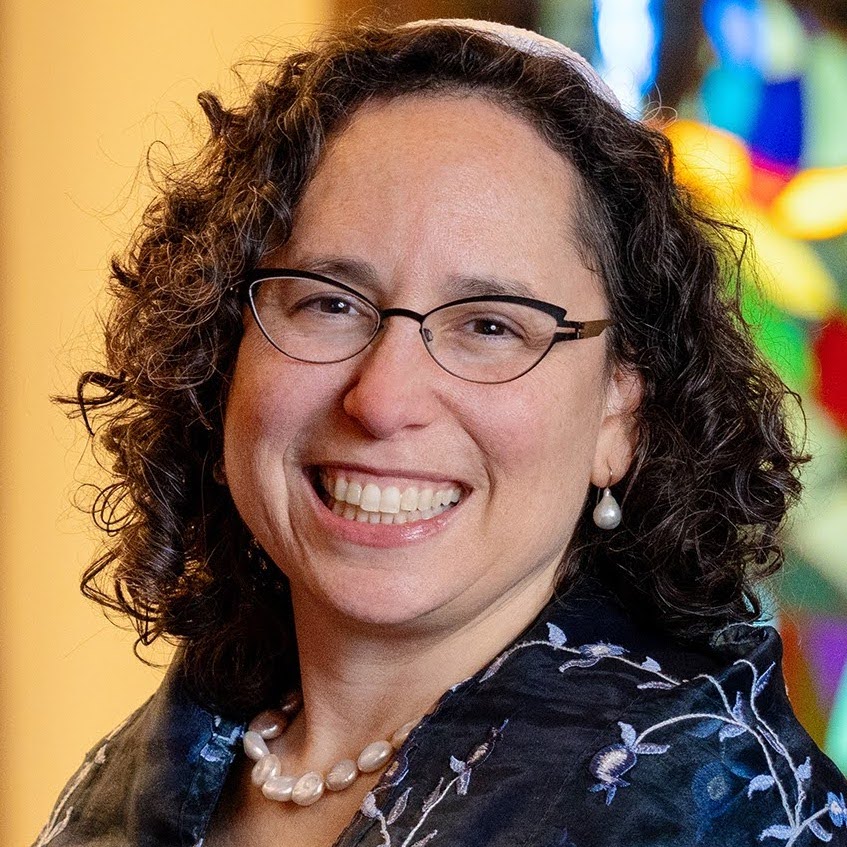
Sermon by Rabbi Julie Roth
This Valentine’s Day, I want to talk about love. Not the love of romantic, candlelight dinners and long-stemmed roses, but the love of bedpans and long drives to the hospital, the love of holding someone’s hand when they can no longer respond to your words, the love Shir Hashirim, the Song of Songs describes as being as “strong as death[1]”, love that is even stronger than death. I find myself thinking about this kind of love, the love I shared with my mother, in this week, the first week since I got up from shiva. And as I try to hang onto her love, or perhaps more precisely, settle into being loved beyond death, I am curious how this type of love can be a window into love Eternal, into God’s love.
* * *
We are loved, loved, loved, by unending love, an unending love.
We are loved, loved, loved by unending love, an unending love.
I first heard this song on a Shabbat morning, as the prayer immediately preceding the Shema. I was at Rommemu, a renewal congregation in New York City, led by Rabbi David Ingber. In the style of a chant, we sang these words, over and over and over again, letting them wash over us. Even more than the traditional words we recite before the Shema in the morning liturgy, ahava raba ahavtanu, you have loved us with abounding love, or the traditional words we recite in the evening immediately preceding the Shema, ahavat olam…ahavta, you have loved us with an everlasting love, these words in English, shifted into the present tense, we are loved, and repeated, loved, loved, loved, always penetrated beyond rote recitation to something deeper, something felt emotionally.
* * *
Some of the hardest moments of this week have been coming to work and leaving work to go home. It was during these times of transition, whether I was walking or driving, that I most often called my mom for our daily check-ins. The first few days, I just felt her absence, the reflex to dial her number on my phone, the inability to hear her voice. I would look at the time and wonder who else could I call instead, but I didn’t want to speak wth anyone else. And I felt, in those moments, very alone. And then one day in the middle of the week, when the instinct to call my mom arose, and I remembered once again that she had died, I heard a melody arise internally, a song I had not sung in many years. And I wondered, what does it mean to be loved by unending love?
* * *
In his book, Judaism is About Love, Rabbi Shai Held identifies the family as the school where we learn to love ourselves, each other, and ultimately God. He writes, “GOD LOVES US, but God’s love is mediated and experienced, at least initially, through the love shown to us by human caregivers. We sense the possibility of God’s love only because we experience human love – most commonly at home, in families.”[2] In other words, it is our experience of being loved by other human beings, in particular our parents, if we are blessed with loving parents, that helps us understand what it means to be loved by God.
And ideally, Rabbi Held teaches, “at least, parental love would be unconditional. We would love our children in much the same way that God loves us: with expectations but without conditions.”[3] This type of love includes expectations, but is not conditioned on those expectations being met. This is a very complicated path to navigate, one in which our love is not dependent on expectations being met, one in which our love is unconditional, but not without expectations.
It is the very same love that Judaism describes in different teachings. On the one hand, God loves us intrinsically, simply because we are created in the image of God as Rabbi Akiva teaches in the Talmud, “Beloved is the human being, for he was created in the image of God.”[4] On the other hand, it is a love that is linked to obligation, a love that is expressed at Sinai, a love that entrusts us with a covenant, a love we demonstrate, in turn, by fulfilling God’s commandments, God’s expectations that we live lives of holiness, kindness, and justice.
* * *
The v’ahavta prayer, the first paragraph that follows the Shema, commands us to love God b’chol l’vavcha, with all our heart, b’chol nafshecha, with all our soul, u’vechol m’odecha, and with all of our might. This raises the classic question, can we be commanded to love? Modern Biblical scholar, Jeffrey Tigay, the author of the JPS Commentary on the Book of Deuteronomy, notes that the Torah does sometimes command us to feel a particular feeling, citing the example from Leviticus, “You shall not hate your kinsfolk in your heart…you shall not bear a grudge against your countrymen.”[5] But he argues that the commandment to love God in Deuteronomy, in the passage we know as the v’ahavta prayer, is not only speaking to an emotional attachment, but to a love that is expressed through action.[6]
This idea that the love we express for God is not merely an occasional declaration in words, but manifest in daily actions can be derived directly from the continuation of the v’ahvta prayer. “Teach them to your children, speak of them when you are at home or walking on the way, when you lie down and when you rise up.” And even more explicitly in the actions of wearing tefillin and mezzuzot, “bind them as a sign upon your hand” and “write them on the doorposts of your house.”[7] This is further reinforced by the third paragraph of the Shema which explicitly mentions tzizit as a reminder of our obligation to fulfill the commandments, all 613 of them, symbolized in the wrapping and knotting of the threads of the fringes themselves.
But the argument that the v’ahvta prayer commands us to love God through actions, rather than emotions, is also made by comparing the opening line “and you shall love” to ancient Near Eastern vassal treaties. Strikingly, these treaties customarily use the term “love.” For example, an early- seventh-century B.C.E. Assyrian treaty calls on the people to “love the crown prince, Ashurbanipal, as you do your own lives.” Love, in this ancient Near Eastern context, “is therefore a technical term for acceptance of treaty obligations.” In the v’ahvta prayer, we are asked to love God by keeping the commandments always in mind, teaching them to the next generation, and surrounding ourselves with reminders of them.[8]
* * *
During this very intensive period of caring for my mom while she was in the hospital, and later in hospice, something shifted in our relationship. She was still first and foremost my mother, but she was far more vulnerable than she ever had been, needing not only my presence and loving attention but also my diligence in reminding her to eat, even though she no longer had an appetite for food, and my advocacy in the midst of a fragile and ever-changing medical landscape. Throughout this time, my mother was clear about her situation and what she wanted, but some of the details were fuzzy, the timing of the last hemoglobin test, the particular word she was searching for, the best path forward.
My mother was hesitant, at first, to accept this new dynamic. She didn’t want to burden me, and she couldn’t imagine how I could spend so many hours with her and driving back and forth, given my busy job and my obligations at home. In the first week, I joked with her and told her that being in the hospital with her was good ‘on the job training.’ And then as the weeks continued, I explained that I had made arrangements with Shomrei to cover with my work, and there was no place I’d rather be. And still she said, ‘I don’t want to be a burden’. I remember telling her she wasn’t a burden, but feeling like I had not adequately responded to her concern. On the drive home, when I recounted the conversation to my friend Rabbi Andi Merow, she said, “it’s not a burden to care for your mom in this way, it’s an honor.” And something clicked. Suddenly, I truly understood the commandment kibud av v’am, to honor your mother and father, and suddenly I understood that obligation towards the one who gave you life, who loved you with unending love, who taught you how to love, is not a burden, but an honor.
* * *
I am not sure what happens to our souls after we die, but I believe the soul is eternal, and it lives on somehow beyond its manifestation in a physical body. And I sense that somehow the soul that belongs to one human being in their lifetime merges with other souls, after death, into something we sometimes understand as God. And I know that the love we experience when a person is alive can still be experienced after they die. It’s not only memory that is a blessing, but love itself. And it’s not the memory of love, but love in the present, in a new form. And this week, in a moment when I longed to speak to my mom in the realm of telephones and voices, in the physical dimension of the living, I heard a song that reminded me that we are loved by an unending love. At first, I understood that to be my mother’s love, a love that doesn’t end with her death. And then I wondered if that spark of love that transcends the boundaries of life and death might just be understood as God.
* * *
I find myself re-reading a letter my dear friend Imam Sohaib Sultan wrote to his young daughter, Radiyya, before he died of cancer at age 40. He wanted her to understand that she could still feel his love, even after he no longer walked on this earth. He wrote, “By the time you learn to read this, it may very well be that your Abba has probably returned to Allah…
I wish I could be there in person to explain it to you and talk it through with you. But seeing this is not our fate, I simply want to say, I love you.
What does it mean to say, I love you? It means that I really feel your emotions when you are happy or sad or angry or peaceful – I want to know why and I also want to feel with you. You matter to me. I care about you. I think about you all the time. I want to hold you. I want to embrace you. I want to stroke your cheeks, comb your hair, cuddle with you with all of my energy..
But, can I love you in this way when I am no longer here? Yes, I believe so… This soul of mine will always live on with this soul of yours. It is through this soul that I will love you and show you love in all these meaningful ways and more. Just be open to what I’m saying, and you will experience my love. I promise.
* * *
We are loved, loved, loved, by unending love, an unending love.
We are loved, loved, loved by unending love, an unending love.
* * *
Happy Valentine’s Day and Shabbat Shalom.
[1] Song of Songs, 8:6.
[2]Rabbi Shai Held, Judaism is About Love, p. 79.
[3] Rabbi Shai Held, Judaism is About Love, p. 91.
[4] Mishnah Avot 3:14.
[5] Leviticus, 19:17.
[6] Jeffrey Tigay, JPS Torah Commentary, p. 77.
[7] Deuteromy 6:5-9.
[8] Marc Bressler, My People’s Prayer Book: The Sh’ma And Its Blessings, 101.
Other Sermons and Talks from the Bimah
See the blog category: Sermons & Talks
Video Archive
The archive of all Shomrei videos is available on our YouTube Channel at shomrei.org/video