Erev Rosh Hashanah Sermon
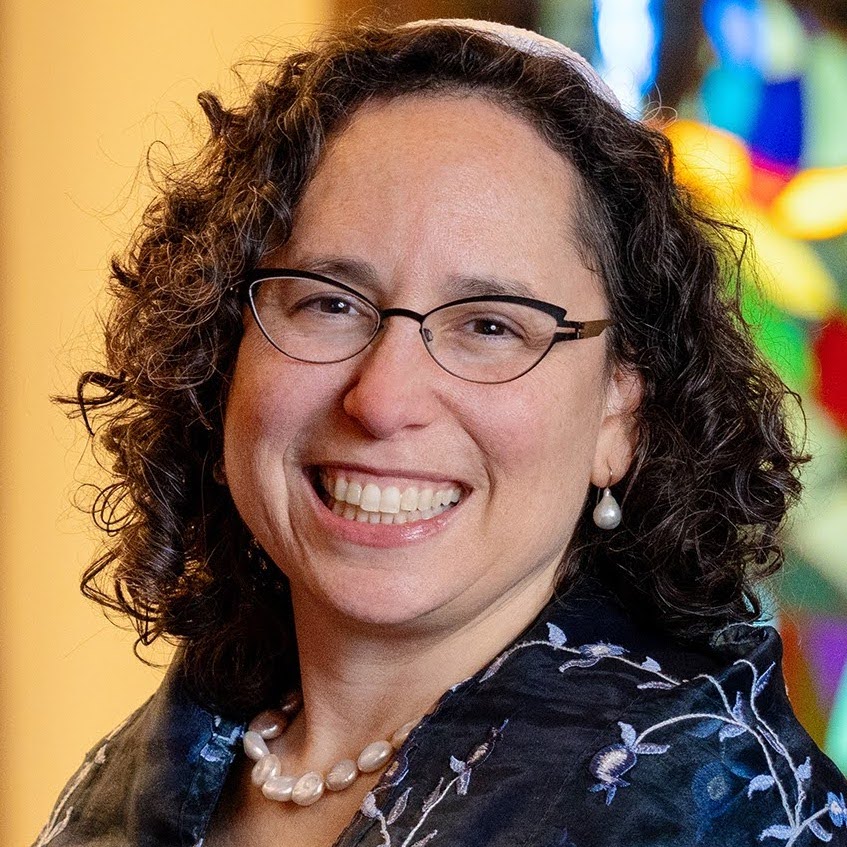
Rabbi Julie’s sermon for Erev Rosh Hashanah 5787/2026, “From Destruction to Light”
On the morning of September 11, 2001, I was meeting with a mentor in downtown Manhattan, the rabbi who would one day officiate at my wedding to Justus, though Justus and I had not yet met. I remember standing dumbfounded in front of a large television screen, watching the flames of fire leap out of the first tower of the World Trade Center. When the second plane hit, our sense of safety, of normalcy, of certainty was shattered. I decided to head home by subway to the Jewish Theological Seminary, where I was studying to be a rabbi.
When the subways stopped running and the people of New York City poured into the streets, we could smell the smoke in the air; we could feel it in our lungs. Strangers were muttering to each other, ‘I can’t believe the towers fell, I can’t believe the towers fell.’ I remember my confusion and denial until I realized that the towers had collapsed while I was underground on the subway. As I walked uptown, I tried to call my parents to tell them I was safe, stopping at every block to use the payphone, but the call would not go through. The phone lines were jammed. The city was on fire.
* * *
The Talmud teaches, “Whoever destroys a single soul, destroys an entire world; whoever saves a single soul, saves an entire world.” On 9/11, 2,977 souls were lost.
* * *
This week, to mark the 25th anniversary of the September 11th attacks, a light show took place over New York Harbor. Perhaps you have seen the video. In the night sky, there are 2,977 points of light, each representing one of the souls that were lost. The points of light first join together to form two double helixes, and then the dots of light form the outline of the two twin towers, majestic and haunting. Each of these lights represents a human life that was extinguished, a human story, an entire world. Tonight I want to share the story of one of those points of light, Abe Zalmanowitz. This tribute was written by Michael Feldstein.
* * *
Abe Zalmanowitz was a 55-year-old computer programmer who was faced with an agonizing choice on an otherwise routine Tuesday morning: Save himself, or remain behind with a disabled friend who could not escape without help.
He chose his friend.
Abe Zelmanowitz was born in New York City on Dec. 30, 1945. He lived in Brooklyn with his older brother Jack and Jack’s family. He was a devoutly observant Orthodox Jew whose commitment to Jewish life was absolute—he routinely walked three miles each way on Shabbat to visit his family. He loved music, played a formidable game of chess, and possessed a dry sense of humor. Exceptionally gifted with his hands, Abe could build a complete sukkah without using a single nail.
When New York’s garment industry began to decline, Abe retrained himself in computer programming, eventually landing a job at Empire Blue Cross and Blue Shield in the World Trade Center in 1989. Colleagues instantly recognized him as a gem—polite, sharp, analytical and unfailingly helpful.
It was at Empire Blue Cross that Abe formed a deep friendship with a colleague named Edward “Ed” Beyea.
Ed was paralyzed from the neck down. Despite using a motorized wheelchair and requiring a full-time aide, Ed lived with inspiring independence, taking public transit to work and operating his computer using an adaptive mouth-stick device.
Abe was Jewish; Ed was Catholic. Both were single, worked long hours and frequently ate dinner together after work. Their friendship was defined by a beautiful, unspoken reciprocity: When Ed chose the restaurant, he made sure it was kosher; when Abe picked the spot, he ensured it was fully wheelchair accessible. They looked out for one another in life—and, as it turned out, in death.
When American Airlines Flight 11 slammed into the North Tower, Abe and Ed were working on the 27th floor.
The impact was devastating. Elevators were destroyed, leaving Ed with no realistic way to descend dozens of flights of stairs. As smoke filled the corridors and panic ensued, people began to rush toward the stairwells.
Abe was physically capable of walking down the stairs and saving his own life. Ed was not.
Co-workers begged Abe to leave, but he refused. “No,” he said firmly. “I’m staying with my friend.” He instructed Ed’s aide to evacuate, promising that he would look after Ed.
Abe wasn’t confused by the chaos, nor was he frozen by fear. He understood the danger clearly. However, in a moment of remarkable moral clarity, he decided that his friend’s life was worth risking his own for.
While waiting on the 27th floor for emergency personnel, Abe spoke with his family by telephone. When a family member asked how long he planned to stay in the burning tower, Abe replied simply: “Until the Mashiach comes.”
Then, the story took an even more remarkable turn. FDNY Captain William “Billy” Burke Jr. reached the 27th floor and encountered the two friends. Seeing their situation, Captain Burke ordered his fellow firefighters to continue down the stairs while he stayed behind to assist Abe and Ed. Together, they managed to maneuver down to the 21st floor.
At 9:59 a.m., the South Tower collapsed, sending a tremor through lower Manhattan. Everyone in the North Tower instantly realized their time had run out. Yet Captain Burke refused to abandon Abe and Ed, and Abe refused to abandon Ed.
At 10:28 a.m., the North Tower collapsed. All three men perished.
There is a powerful, sacred chain in this tragedy: Abe wouldn’t abandon Ed, and Captain Burke wouldn’t abandon Abe and Ed. Each man viewed the life of the person next to him as more precious than his own.
Abe’s story endures because his heroism was born not out of duty, but out of pure chesed—loving-kindness. He had no badge, no tactical training and no institutional obligation to stay. Society would have understood had he saved himself. Yet he quietly chose self-sacrifice over self-preservation.
When reporters later asked his brother Jack how Abe could have made such a staggering sacrifice, Jack replied simply that it was just “Abe being Abe.”
Abe didn’t suddenly become a hero on Sept. 11. Sept. 11 simply revealed the hero he had been all along.
May his memory forever be a blessing.[1]
* * *
There is a Hasidic teaching that each year on Rosh Hashanah an Or Chadah – a new light – descends on the world containing all the possibilities of the coming year. Since the beginning of time, the world has never seen this particular light, and we will never see this specific light again. The light symbolizes the potential and hope within the coming year.[2] As we remember the 25th anniversary of 9/11 on this, the first day of Rosh Hashanah 5787, may we go from destruction to light.
May the memory of the righteous always be a blessing.
May we all be inscribed in the Book of life, peace, and resilience.
[1] This tribute to Abe Zelmanowtiz was written by Michael Feldstein – Sept 10, 2026
[2] Rabbi Naftali Brawer, ‘The Light That Has Never Been: A Rosh Hashanah Reflection’, Sept 10, 2026
Rabbi Julie’s Videos
An archive of Rabbi Julie’s videos is available on our blog
Video Archive
Livestreams and an archive of all Shomrei videos is available on our YouTube Channel at shomrei.org/video