Sermon for Chol HaMoed
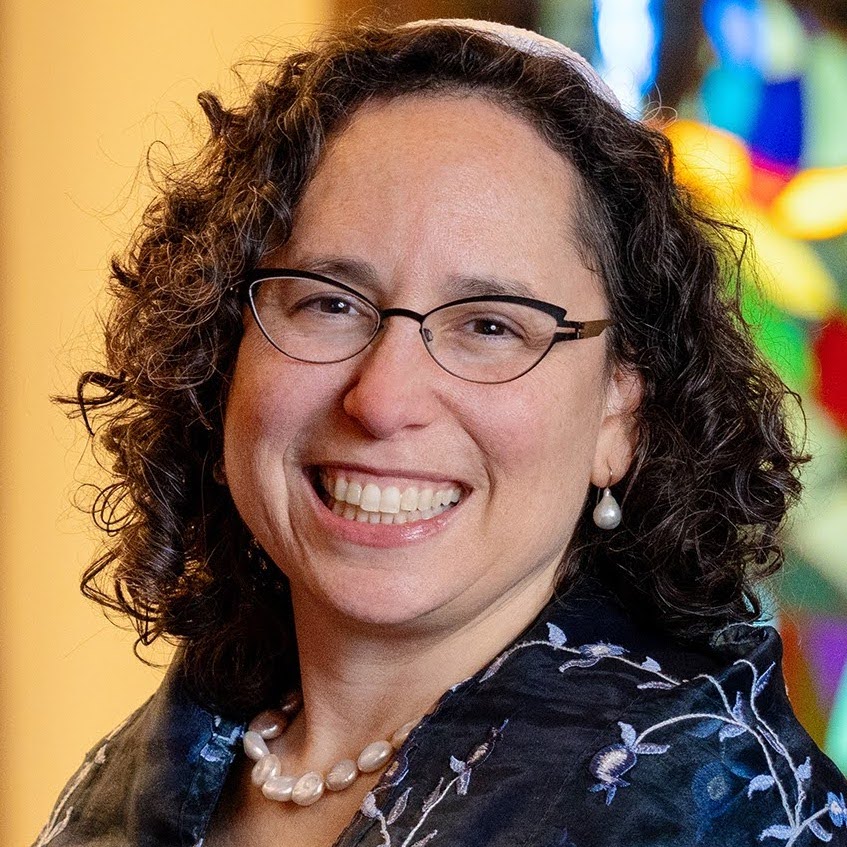
Sermon by Rabbi Julie Roth: Opening the Door to Redemption, Passover 2026
In the seders of my childhood, the table extended all the way from the dining room to the living with the adults seated by seniority at the far end of the dining room and the kids seated together at the far end of the living room, practically on the front lawn. After Uncle Milton died, my father sat at the head of the table, unwilling to skip the parts that were checked off in one copy of the Maxwell Haggadah as approved for skipping by the rabbi, so he would often mumble to himself quietly, until some amount of chit-chatting broke out among his nieces and nephews who immigrated from the Former Soviet Union. At my end of the table, it was almost impossible to know what was going on half of the time. Sometimes I would sit under the table playing with my cousin Diana and later we would giggle with our cleverness of singing Day-Day-ana instead of Dayenu.
When the time came to open the door for Elijah, the kids were sent to open the heavy wooden front door. We almost never used our front door; we always came in the side door, but somehow it was understood that Elijah, being a special guest, would come in through the front door. There was no direct sight-line from the seder table to the front door so either they would call out to us, “is the door open yet?” or one of us kids would run back to the table, while others held the door open, nodding or giving a thumbs up sign, and then run back to the front door passing the baton in a relay race for the redemption of the world. I never gave it a second thought back then. I never wondered why the adults stayed in their seats and left it to us to open the door. I figured we were closer, or maybe we had spilkes in tuches, and needed to run around at that late hour, or maybe it was because it could even snow on Passover in Cleveland, and the adults didn’t want to stand in the cold with the door open. But the message was clear. It was the job of the young people to open the door for Elijah.
* * *
The practice of opening the door for Elijah at our Passover seders was a relatively late addition. We don’t know precisely when the ritual was added to the Askenazi seder, but the consensus is sometime during the Middle Ages, after the Crusades [1]. It was a terrible time in Jewish history when the Crusaders joined together with local peasants to terrorize and murder Jewish communities along the Rhine and the Danube and in France on their way to Jerusalem. No wonder they felt the need to add a call for immediate redemption to the Passover seder.
The custom of opening the door for Elijah was accompanied by the words, “pour out Your wrath”, a call for vengeance against our enemies. “Pour your wrath upon the nations that did not know You and upon the kingdoms that did not call upon Your Name!… You shall pursue them with anger and eradicate them from under the skies of the Lord.” If this doesn’t sound familiar, the words might not be in your Haggadah as many modern Haggadot omit them or replace them with an alternate reading, “Pour out Your love.”
Indeed, the model of redemption highlighted in this morning’s Torah reading is quite the opposite of the words added in the Middle Ages to our Haggadah. Instead of calling on God to ‘pour out [His] anger, after the incident of the golden calf, redemption comes through forgiveness. Moses pleads for God to give us a second chance. And in the famous words, Adonai, Adonai El Rahum v’Chanun, Erech Apaim, we evoke mercy and compassion, and call upon God to be slow to anger. We focus internally on what we can change in ourselves, and this leads to mercy and redemption in the form of a second set of the Ten Commandments.
* * *
At the seders I lead, for as long as I can remember, everyone gets up from the table to open the door for Elijah. And we don’t just stand indoors with the door held open, making a little space for Elijah to squeeze through. We all go outside and stand on the porch and sing out to Elijah. I think I must have started this tradition when I was leading seders on campus at Princeton. After all, everyone except for me was a college student. There were no kids to send to the door while the adults sat at the table, everyone was part of the up-and-coming generation.
* * *
At Haifa University, there is a collection of more than six hundred folk tales about Elijah the Prophet, more than any other figure. This is one of my favorites:
A pious and wealth Jew asked his rabbi, “For about forty years I have opened the door for Elijah every Seder night waiting for him to come, but he never does. What is the reason?” The rabbi answered, “in your neighboorhood there lives a very poor family with many children. Call on the man and propose to him that you and your family celebrate the next Passover in his house, and for this purpose provide him and his family with everything necessary for the eight days of Passover. Then on the Seder night, Elijah will certainly come.” The man did as the rabbi told him, but after Passover he came to the rabbi and claimed that again he had waited in vain for Elijah. The rabbi answered: “I know very well that Elijah came on the Seder night to the house of your poor neighbor. But of course you could not see him.” And the rabbi held a mirror before the face of the man and said, “Look, this was Elijah’s face that night.” [2]
* * *
At my Passover seders, when it came time to pour the cup of wine for Elijah, we each poured a little wine or grape juice from our cups. As we poured from our cups into Elijah’s cup, we each said something we would do to help contribute to the redemption of the world. Particularly on the second night, when we had a large and diverse crowd, I was struck by the answers. “Speak hard truths”, “teach my children to be good people,” “have patience for others”, “cut through the noise to focus on what matters.” My mom’s husband, Grandpa Stephen was with us. He’s 92 years old, and he said, I never saw this at a seder before. Where does this come from? And honestly, I couldn’t remember, but I know it wasn’t my idea originally.
The power of the ritual is less about what people specifically say and more about the action itself. We can’t sit at the table and wait for the Messiah to come. And we can’t rely on others to open the door for redemption. If we want to see redemption in this world, we must each do our part. In this way, I would argue we aren’t only obligated to see ourselves as if we ourselves went out from Egypt. We are obligated to see ourselves as if we ourselves will bring this world closer to redemption.
Shabbat Shalom.
—————————
[1] David Aronw, Creating Lively Passover Seders, p. 321.
[2] David Aronw, Creating Lively Passover Seders, p. 331.
Other Sermons and Talks from the Bimah
See the blog category: Sermons & Talks
Video Archive
The archive of all Shomrei videos is available on our YouTube Channel at shomrei.org/video