Sermon for Shmini
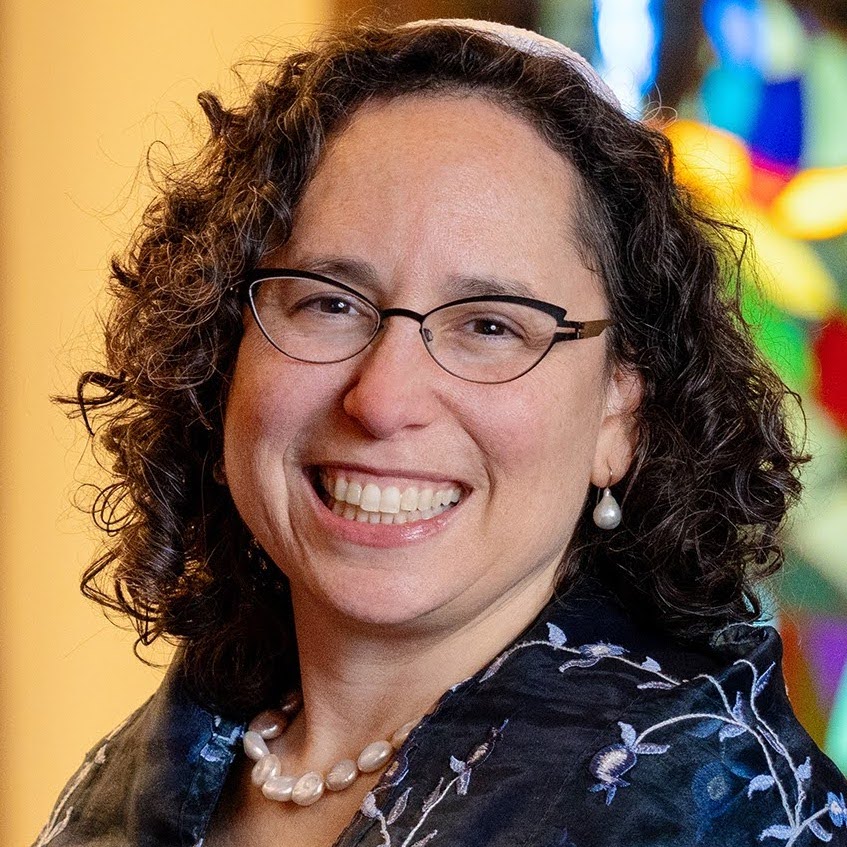
Sermon by Rabbi Julie Roth: Mysterium Tremendum
This Shabbat – the Shabbat between Passover, the Festival of Freedom, and Yom Hashoah, Holocaust Commemoration Day – I find myself fixated on Nadav and Avihu, the two sons of Aaron. I can picture them standing there, in their freshly made linen garments, on the eighth day, the same day as circumcision, ready to inaugurate the mishkan, the magnificent desert sanctuary.
I wonder how close they were standing to the altar when their father sacrificed the calf for the purification offering for their family, and then the goat for the people’s purification offering. What were they feeling each time they brought the blood to their father and he dashed it on the altar? Were they nervous, proud, excited, terrified? What was the expression on their faces? Were their hearts beating faster? Were they smiling, even beaming, when their father blessed the people? And did they also fall on their faces and shout, with the rest of the people, when the “fire came forth and consumed the burnt offerings and the fat parts on the altar?”
* * *
Rudolph Otto – a Lutheran theologian – died in 1937, just as the Nazis were coming into power in Germany. He was most famous for writing about the internal, emotional experience of the Divine. He described our fundamental, non-rational experience of God along two opposing poles, the mysterium tremendum and the mysterium fascinans. Both experiences were an encounter with an inexplicable, wholly other, mystery. In one case, the mysterium tremendum, evoked an overwhelming and daunting sense of smallness, humility, submission, even fear. In the other case, mysterium fascinans, the opposite, a sense of comfort, fullness, fascination, even bliss.
Both mysteries can be understood as a kind of awe. In one case, much like the wonder many of us felt these past 10 days as we watched the astronauts travel to the far side of the moon and back, there is a sense of amazement. This, I imagine, is what our ancestors felt at the end of Exodus when they finished the work of building the Tabernacle and k’vod Adonai malei et hamishkan, and the glory of God filled the Tabernacle to the point that Moses could not enter the Tent of Meeting. This was the feeling I remember at my installation when we all held our tallit over our heads symbolizing the mishkan we would build together. This is the awe of mysterium fascinans.
But it’s the mysterium tremendum, that I want to focus on today, the old-fashioned awe of the yamim noraim, the High Holy-Days, the trembling and quaking awe of standing before God in judgment and believing viscerally that our very lives are in God’s hands. This awe, the mysterium tremendum, must have been what our ancestors felt as they heard the cries throughout Egypt on the night of the plague of the first-born as they sat in their houses, loins girded, hoping the blood on the lintels of their doorposts would protect them. The fire that came forth to consume the burnt offerings on that eighth day, was another manifestation of the kavod of God. And it was that same mysterium tremendum that came forth and consumed Nadav and Avihu when they offered that eish zarah, that strange fire. It was the mysterium tremendum that killed them instantly.
* * *
When I was growing up, corporal punishment was still acceptable, within limits. In fact, the principal at Wiley Middle School had a wooden paddle in his office that he used on students as an alternative to detention. I was a goody two-shoes, so I never got paddled, but my brother Mark did. Likewise, my father never spanked me, but my brothers talk about a few unforgettable times when our father taught them a lesson.
For context, when my father was growing up in Munkach, before the war, there weren’t enough books at heder, at Hebrew school, for each kid to have their own. So they would sit, four to a book, reading the page sideways and upside down when it was their turn. One time, another kid played a prank on my father, covering the page with his hand when it was my father’s turn to read. When my father hesitated, the rabbi smacked him on his knuckles with a wooden stick. This escalated into a fight between my father and the other kid, which my father won, so the kid’s older brother came after my dad, and when my father hit the older brother, the trouble-maker’s father came after my father. And well, the story ended with my father saying, that’s why he always carried a sock with rocks in it in his pocket.
So even though my father toned it down quite a bit when he immigrated to America, if my brothers were bothering me when I was kid, wrestling me to the ground and not letting go, for example, I would call out ‘daddy’to my father in the next room and he would start to unbuckle his belt. If my brothers heard the sound of metal clanking as my father unbuckled his belt, they would stop immediately. I don’t think they would have stopped if my father had only threatened to hit them, but never actually done it.
* * *
The commentators speculate about what Nadav and Avihu did wrong to deserve such a punishment. Some say they were drunk, because there’s a prohibition against drinking on the job, for Aaron and his sons, immediately following this incident. And if Nadav and Avihu were drinking, I wonder if they were saying a celebratory l’chayim or taking a quick shot to calm their nerves. Others say Nadv and Avihu didn’t follow instructions. If only they had mixed the incense in the firepan exactly as directed, if they had shown no initiative or disobedience, they would still be alive. All of these explanations try to make sense of tragedy, try to safeguard the rest of us from the fear that we too could be instantly killed by God. The mysterium tremendum is a little less mysterious, a little less terrifying, if there’s at least an explanation. If at least Nadav and Avihu are at fault. But I think Aaron’s silence says it all.
* * *
My father tells another story, from the time when he was a teenager, a story that took place less than a decade after Rudolph Otto died. It’s the story of the day the mysterium tremendum died. It was Shabbat and my father was working under Nazi gunpoint. It was the first time he ever violated the Sabbath in his life. He never talked about what kind of work he was doing, only that he was waiting for God to strike him down, like Nadav and Avihu. My father had been raised with a very traditional faith, and when he translated those verses from Hebrew to Yiddish in heder about the consequences of working on Shabbat, mot yumat, he believed he would surely die. He waited all day for God to strike him down. But it was a clear blue day. Not a cloud in the sky. And when my father lived through that day, and he was still standing, the mysterium tremendum died. He wasn’t angry at God for allowing the Holocaust to happen, and he didn’t stop believing in God all together. But when God did not strike him down, his belief in God changed.
Alongside his mother and father, his six youngest brothers and sisters, my father lost his belief in the mysterium tremendum in the Holocaust. And that loss was experienced not only by him and by other survivors, but by the generations of Jews that came afterwards. We might have lost our belief in this type of God anyway, through advances in science and scholarship, through modernity and the enlightenment. And I’m not sure that I want to live in a world dominated by the God who killed Nadav and Avihu. But I also want to take a moment to acknowledge that something was lost. And rather than glossing over or rushing past this part of our tradition, I want to take a moment to acknowledge that something precious was lost that day the mysterium tremendum died.
* * *
On Passover, at the end of the seder, our family loves to sing Chad Gadya. We know a ridiculous melody that’s so fun to sing and then of course, there’s the noises. It’s relatively easy to make the sound of the goat and the cat and the dog, even the stick. But it’s surprising hard to distinguish between the sound of the shochet who slaughters the ox and the angel of death. And we’re also never really sure how to make a sound for Hakadosh Baruch Hu, the Holy Blessed One. This is one of those Jewish songs that endures because of its melody, rather than because of its words.
The lyrics are actually quite gruesome. The cat that ate the goat, was bit by the dog, who was hit by the stick. And there’s the fire that burns the stick, and the water drunk by the ox and the shochet. And then when the angel of death comes, it no longer feels like a silly song about a goat my father bought for two zuzim.
On the night of Passover in Egypt and on the eighth day of the inauguration of the mishkan in the desert, it’s not so clear if the angel of death is separate from God or God Himself. And if we really think about it, or as Rudolph Otto would have it, if we allow ourselves to access without thinking, the terrifying feeling of God as mysterium tremendum, then we know that we can’t have the God who slays the angel of death without the God that is the angel of death. No matter what the last verse of Chad Gadya says.
And while I know in my kishkes that this tradeoff is worth it, or is the only way I can continue to believe in God after the Holocaust, even though I would make this choice again and again, by believing that God is not the angel of death, I am left believing in a God who cannot or will not slay the angel of death. So my obedience is inspired by love, not fear.
I listened to my father, and I behaved not because I feared the unbuckeling of the belt, but because I yearned for the embrace. And because I did not want to add to the hurt of one who had been hurt beyond comprehension. And I listen and obey Hakadosh Baruch Hu not for fear of punishment but out of love and gratitude and yearning.
And while I prefer not to fear God and not to see God as the angel of death, I also know that something precious was lost. Because now God does not split the sea for us, or drown our enemies. God no longer protects us from the angel of death. And God no longer redeems us with a mighty hand and an outstretched arm Instead, our redemption, and the redemption of the world, is in our own hands.
Shabbat Shalom.
Other Sermons and Talks from the Bimah
See the blog category: Sermons & Talks
Video Archive
The archive of all Shomrei videos is available on our YouTube Channel at shomrei.org/video